
The rules of digital commerce just changed overnight. If you built your growth playbook around SEO, paid search, and click-through rates, you are already playing catch-up. In 2026, AI agents are browsing, comparing, and buying on behalf of consumers — and Generative Engine Optimization (GEO) is the new battleground where brands are won or lost. This is the growth hacker’s definitive guide to understanding, entering, and dominating this new frontier.
What Is Agentic Commerce — And Why It Matters Right Now
Agentic commerce is the next evolution of e-commerce. Instead of a human typing into a search bar, clicking through product pages, and manually checking out, AI agents do all of that autonomously. A shopper gives ChatGPT a goal — ‘Find me a waterproof running shoe under $120 with good reviews’ — and the agent searches merchant catalogs, compares specifications, and completes the purchase, all within a single conversation.
This is not science fiction. ChatGPT’s Instant Checkout launched in September 2025, followed by Google’s Universal Commerce Protocol (UCP) in January 2026, backed by Walmart, Target, Shopify, PayPal, Visa, and 20 additional partners. McKinsey projects agentic commerce will redirect $3 to $5 trillion in global retail spending by 2030, with up to $1 trillion coming from the United States alone. AI platforms already account for an estimated $20.57 billion in US retail e-commerce sales in 2026, nearly quadrupling the prior year’s figures.
For growth hackers, the implication is stark: the entire customer acquisition funnel is being compressed and automated. Brands that optimize for AI visibility now will compound their advantage. Brands that wait will be algorithmically invisible. Our Growth Intelligence Engine framework is built precisely to help you move faster than your competitors in exactly these moments.
GEO vs. SEO: Understanding the Fundamental Shift
Generative Engine Optimization (GEO) is the practice of structuring your brand, content, and product data so that AI engines — ChatGPT, Google AI Mode, Perplexity, Gemini, and Claude — cite, recommend, and surface your brand when generating answers for users. While SEO optimizes for a ranked list of blue links, GEO optimizes to be the trusted source inside a synthesized AI response.
The term was formally introduced in a 2023 Princeton University research paper and has since become the dominant framework for AI-era content strategy. The gap between the two disciplines is significant and widening. Here is how they compare:
Dimension | Traditional SEO | Generative Engine Optimization (GEO) |
Goal | Rank in search results | Be cited in AI-generated answers |
Key Metric | Click-through rate (CTR) | AI citation rate / Share of Model |
Ranking Factors | Backlinks, keywords, page speed | E-E-A-T signals, structured data, earned media |
User Behavior | User clicks a link | Agent completes task autonomously |
Content Focus | Long-form keyword pages | Direct answers, FAQ schema, structured snippets |
Discovery Channel | Google SERP (10 blue links) | AI response (2-7 cited sources on average) |
SEO vs. GEO — Key differences for growth teams in 2026
The numbers reinforce the urgency. AI-referred sessions jumped 527% year-over-year in the first half of 2025. Visitors arriving from AI citations convert at 4.4 times the rate of traditional organic visitors. And LLMs cite only 2 to 7 domains per response, compared to Google’s 10 blue links — meaning the stakes of being included or excluded are dramatically higher. Our Technical SEO service and GEO: AI Optimization work together to cover both layers of this new discovery landscape.
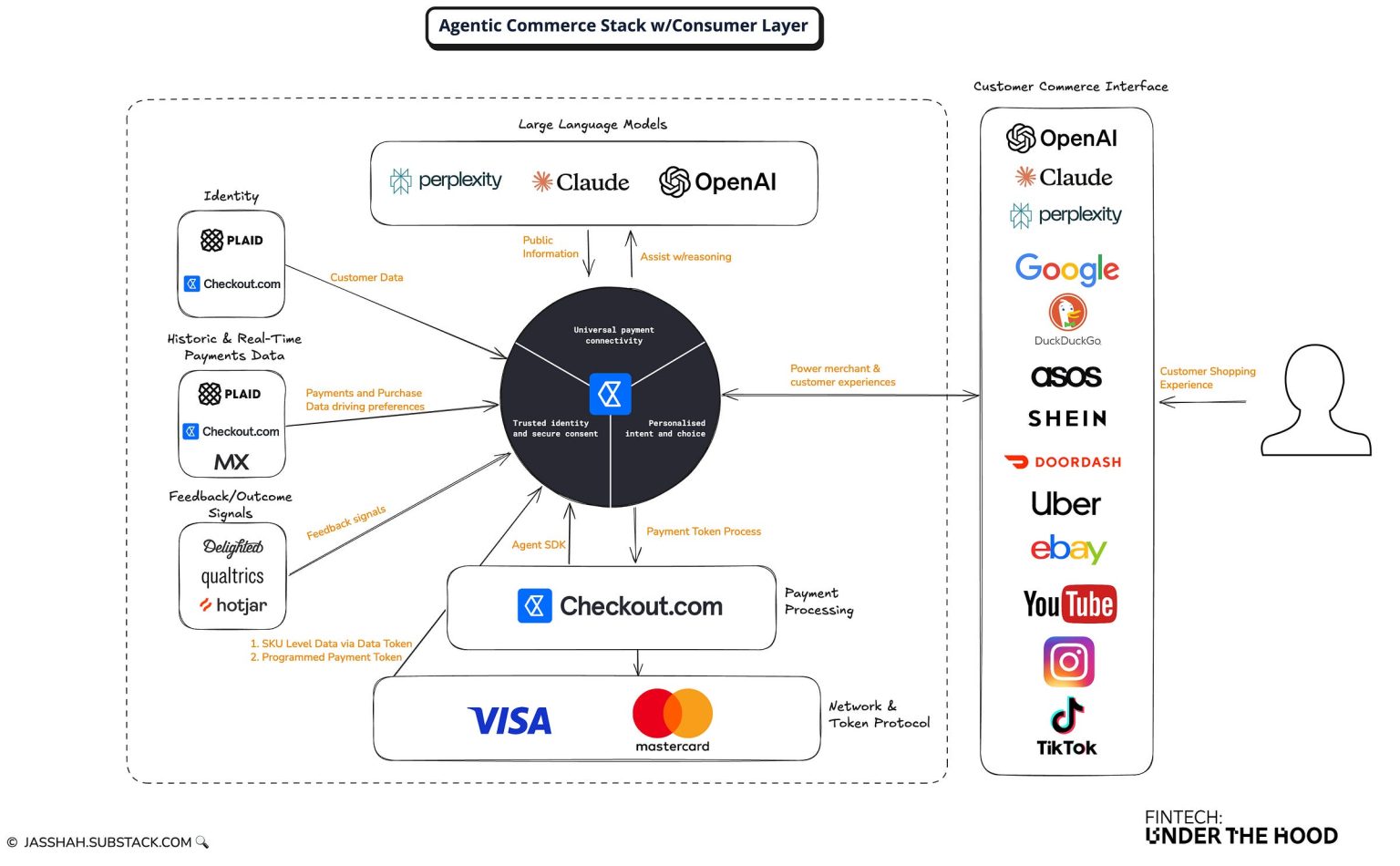
The Agentic Commerce Stack: Protocols Every Growth Hacker Must Know
To win in agentic commerce, growth hackers need to understand the infrastructure layer. Three protocols now determine whether AI agents can find, evaluate, and transact with your products.
Agentic Commerce Protocol (ACP)
OpenAI’s protocol, built with Stripe, powers ChatGPT’s Instant Checkout. Launched in September 2025 for Plus, Pro, and free US users, it includes partners like Etsy, Shopify, Walmart, and Target. OpenAI charges merchants a 4% transaction fee on completed purchases. The shopper never leaves the ChatGPT interface.
Universal Commerce Protocol (UCP)
Google’s open-source protocol, announced at NRF in January 2026, was co-developed with Shopify and endorsed by 20+ partners including Home Depot, Lowe’s, Best Buy, Macy’s, Visa, and Mastercard. UCP enables AI agents to complete shopping transactions across retailers and payment providers. Its open architecture is designed to become the industry standard.
Model Context Protocol (MCP)
Originally built by Anthropic and now governed by the Linux Foundation, MCP is the general-purpose tool-connection standard that enterprise catalog integrations from Salesforce and Adobe rely on. Whether you are running a store on Shopify, WooCommerce, or Magento, connecting your catalog to these protocols is now a growth priority, not a technical afterthought.
The strategic implication is clear: if your product data cannot be read, queried, and transacted by these protocols, your brand does not exist in the agentic shopping funnel. Machine-readable inventory, accurate real-time pricing, and reliable availability data are non-negotiable. Our E-Commerce Solutions team can help you audit and upgrade your data infrastructure for agent-readiness.
The GEO Growth Funnel: A 5-Stage Framework
Growth hackers need a systematic model for GEO just as they have always had for SEO. Here is a five-stage funnel that maps the journey from invisible to consistently cited by AI engines. Read our in-depth guide to building your Growth Intelligence Engine in 90 days for the full operational playbook.
FOUNDATION — Technical Readiness
Ensure your site is crawlable by AI bots (ChatGPT-User, PerplexityBot, ClaudeBot). Implement schema markup (Product, FAQ, Article, HowTo). Our Technical SEO service covers crawlability, Core Web Vitals, and schema implementation end-to-end. Achieve sub-1-second API response times and clean your product data — accurate pricing, live inventory, complete specifications.
ENTITY AUTHORITY — Own Your Brand Identity in AI
Build consistent entity signals — your brand, products, and people must be clearly defined across your website, Wikipedia, LinkedIn, G2, and Reddit. AI engines resolve brand identity through these signals before citing you. This feeds directly into our Voice of Customer intelligence layer.
CONTENT ARCHITECTURE — Structure for AI Synthesis
Lead every page section with a direct answer in the first 40-60 words. Include statistics every 150-200 words. Build comprehensive FAQ sections. Our Content Sprints service produces GEO-optimized content at velocity — structured for AI retrieval, not just human readers.
EARNED AUTHORITY — Third-Party Credibility
GEO is harder to game than SEO because AI engines heavily favor earned media from reputable news outlets and trusted review platforms. Invest in PR, thought leadership, and getting your brand mentioned in authoritative sources. Publish original research that others will cite.
Stage 5: MEASUREMENT — Track What AI Says About You
Monitor AI bot traffic in GA4. Track your brand’s Share of Model using tools like Ahrefs Brand Radar or SEMrush AI Visibility Toolkit. Start with a comprehensive SEO Audit to establish your baseline before optimizing.
The GEO Growth Funnel: Five stages from technical readiness to measurable AI citation dominance
Growth Hacking Tactics That Work in the GEO Era
Traditional growth hacking was about exploiting gaps in distribution channels before they matured. GEO presents exactly that kind of early-mover opportunity right now, in 2026. Here are the tactics with the highest leverage. For the full operational blueprint, read our Definitive Guide to Winning in the Age of AI-Powered Search.
Restructure Your Top-Performing Content First
Brands that restructure existing high-authority content for GEO see citation improvements within 60 to 90 days — faster than waiting for new content to rank. Start with your top 10 pages. Add a direct-answer opening, include FAQ schema, embed statistics, and update with a visible ‘Last updated’ timestamp. Our Channel Optimization service identifies which pages deliver the highest return when restructured for AI discovery.
Publish Original Research
AI engines have a strong preference for unique, data-driven content. If you publish a benchmark study, a proprietary dataset, or a framework no competitor has, AI engines have a concrete reason to cite you rather than a dozen lookalike alternatives. Pair this with Location Intelligence data if you serve geo-specific markets — regionally unique insights are especially citation-worthy.
Optimize Your Product Data Infrastructure
For e-commerce brands, product discoverability in AI-generated answers depends entirely on how well LLMs understand your catalog. Whether you run your store on Shopify, WooCommerce, or Magento, clean product titles with full attribute detail, accurate materials and dimensions, live inventory via API, clear return policies, and verified pricing are the foundation of agentic visibility. If your inventory is not machine-readable, AI agents will skip your store.
Implement llms.txt
The emerging llms.txt standard — similar to robots.txt but designed for AI agents — allows you to explicitly tell large language models what content to prioritize from your domain. Our Technical SEO team can implement this as part of a broader AI-readiness audit.
Win the Protocol Race Early
Brands already integrated with Shopify’s Agentic Storefront, OpenAI’s ACP, or Google’s UCP gain infrastructure advantages that will compound as agentic commerce matures. The window for first-mover advantage in protocol adoption is 2026. Explore our Agentic Commerce service to understand what integration looks like for your store.
The Agentic Commerce Numbers: Why This Cannot Wait
Growth hackers make decisions based on data. Here is the data that defines the urgency of the GEO and agentic commerce opportunity in 2026.
Key Metric | Data Point |
Global agentic commerce market by 2030 (McKinsey) | $3 to $5 trillion |
US agentic commerce sales in 2026 (eMarketer) | $20.57 billion |
AI-referred sessions growth, H1 2025 (Previsible) | +527% year-over-year |
Conversion rate lift, AI-referred vs. organic (Semrush) | 4.4x higher |
AI influence on Cyber Week 2025 global sales (Salesforce) | ~20% of digital orders |
Consumers using AI for purchase research (Profound) | 79.7% |
ChatGPT weekly active users, late 2025 (OpenAI) | 800+ million |
AI citations per LLM response (Profound) | 2 to 7 domains only |
B2B buying to be AI agent-intermediated by 2028 (Forrester) | 90% |
AI-driven orders on Shopify, YoY growth 2025 (Shopify) | 15x increase |
Key agentic commerce and GEO statistics 2025-2026. Sources: McKinsey, eMarketer, Shopify, Salesforce, Profound, Semrush, OpenAI.
Measuring GEO Success: The New Growth Dashboard
One of the biggest gaps in most organizations’ approach to GEO is measurement. As of late 2025, only 16% of brands systematically tracked AI search performance. That gap is your opportunity. Start with a comprehensive SEO Audit to establish your baseline — you cannot optimize what you have not measured.
Replace your traditional ranking dashboard with AI visibility metrics. Track AI citation frequency — how often your brand appears across AI-generated answers. Measure Share of Model across ChatGPT, Perplexity, Gemini, Claude, and Google AI Overviews. Our Rank Better platform monitors your brand across all major AI engines and delivers competitive gap analysis on a rolling basis.
Critically, watch for brand claim accuracy. AI engines make implicit and explicit claims about your brand — product quality, pricing, competitive position. This is where Conversion Rate Optimization and GEO intersect: even when an AI recommends you, the landing experience must convert. Our RevOps Tech infrastructure ensures your data signals, pricing models, and funnel are aligned end-to-end.
Set a 90-day baseline. Optimize. Measure. Iterate. GEO is not a one-time content tweak — it demands the same ongoing discipline as traditional SEO, but the window for building citation authority before your competitors is open right now. See how we structure this in our Growth Intelligence Engine in 90 Days framework.
Related Reading from RF Studio
Go deeper with these resources:
Agentic Commerce: The Next Frontier for E-Commerce Founders
How to Build Your Growth Intelligence Engine in 90 Days
A Definitive Guide to Winning in the Age of AI-Powered Search
CRO: PPC Performance Optimization
Growth Hacking is a Mindset
The First-Mover Window Is Open
The GEO revolution and the rise of agentic commerce represent the most significant shift in digital growth since the birth of Google. Consumers are delegating their purchasing decisions to AI agents. AI engines are choosing which brands to recommend based on data quality, content authority, and earned credibility. And the brands building that authority right now — through clean product feeds, GEO-optimized content, protocol integration, and rigorous measurement — will dominate the next decade of digital commerce.
The playbook is not complex, but it requires action. Audit your technical infrastructure with a full site audit. Restructure your top content for AI synthesis with Content Sprints. Integrate with commerce protocols through our Agentic Commerce service. Track your AI citations via Rank Better. The growth hackers who act in 2026 will look back at this moment the way early SEO practitioners looked back at 2003: as the window when the rules were still being written and advantage was there for the taking.
The question is not whether to invest in GEO and agentic commerce. The question is whether you will do it before your competitors do. Get started with RF Studio today.