
The $1 Trillion Disruption You Can’t Afford to Ignore
The Wake-Up Call
E-commerce is standing at the edge of its biggest transformation yet. According to Similarweb, traffic from AI-driven browsers and shopping agents has skyrocketed by more than 4,000% in the past year. These aren’t your typical shoppers—they spend more time on websites, make decisions faster, and often skip traditional search altogether.
By 2030, agentic commerce—where AI agents discover, compare, and buy on behalf of humans—could be steering over $1 trillion in retail sales, as reported by Gartner and McKinsey.
If your e-commerce stack isn’t built for these digital buyers, your store might soon disappear from the new search landscape entirely.
What Exactly Is Agentic Commerce?
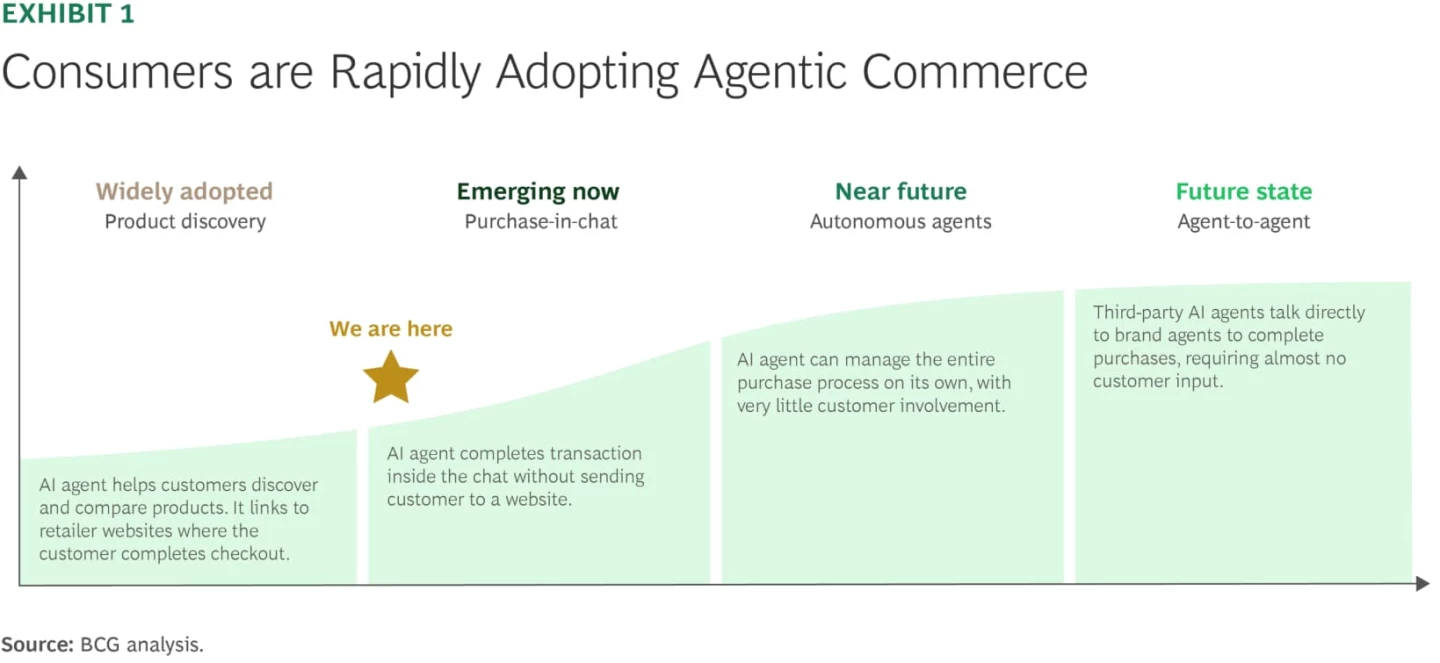
Imagine this: instead of a customer typing “best gym shoes under $120,” their AI assistant simply goes out and finds them. It scans thousands of product feeds, compares features, reviews, and prices, and completes the purchase—all without the shopper ever opening a browser tab.
That’s agentic commerce in action—where AI acts as the customer. These agents, often built into chat apps, wearables, and browsers, don’t rely on how your site looks; they rely on how well your data speaks their language.
From Browsing to Buying in Seconds
In the old e-commerce world, a shopper’s journey looked something like this: search on Google, click through multiple sites, compare prices, add items to a cart, abandon it, maybe return later. The average conversion rate? Barely 3%.
Now picture the same journey powered by an AI agent. The user simply says, “Find me gym shoes for marathon training.” Within seconds, the agent scans a thousand product APIs, checks stock and sizing, and makes the purchase. The conversion rate jumps to 30 or even 40%, and the time spent drops from an hour to half a minute.
The takeaway is simple—if your data isn’t readable by AI, you don’t exist in its world.
Why Founders Need to Move Now
The shift is already underway. Accenture reports that nearly two-thirds of consumers rely on AI-based recommendations or digital assistants when making purchase decisions. By the end of 2025, more than half of online shoppers expect to lean entirely on autonomous shopping agents.
That means what used to be your homepage or ad campaign will soon be replaced by your data feed and your product API.
The Hidden Risks in Every Store
Many e-commerce founders don’t realize how fragile their visibility is in this new world.
If your data doesn’t clearly express what makes your product valuable, AI agents will see you as just another price tag in a list. They don’t fall for your branding or design—they’re driven by structured information like shipping time, material quality, and customer satisfaction.
Without structured data—like schema.org markup or JSON-LD—you’re invisible to AI crawlers powering systems like ChatGPT or Perplexity.
And here’s the kicker: AI doesn’t care about how your store feels; it cares about how accurate, fast, and complete your information is.
How to Build an Agent-Ready Store
You don’t need to rebuild your store from scratch. If you’re using Shopify or WooCommerce, you already have a solid foundation. The real challenge is teaching your system to talk to AI.
Start with your structured data—your products should include detailed, machine-readable fields like stock availability, delivery time, and even use cases (“vegan-friendly,” “for marathon training,” “travel-size”). Freshness matters more than beauty.
Next, make your products accessible through a secure API feed. That’s how agentic platforms like ChatGPT Shopping, PayPal’s AI Marketplace, or Perplexity pull in data. The faster and richer your feed, the higher your chances of being recommended.
Finally, don’t forget personalization. While agents handle the buying, they still rely on context. Building your own customer intelligence layer—tracking preferences, replenishment patterns, and satisfaction signals—keeps your store relevant even when the human buyer steps back.
What the Smart Players Are Doing
This isn’t science fiction—it’s already happening.
SKIMS, for instance, was one of the first Shopify brands to integrate directly with ChatGPT’s instant checkout pilot in 2025. That single move gave them access to over 700 million AI-powered users without spending a dime on ads.
Glossier took a more creative route, connecting AI-powered QR triggers to physical billboards for exclusive drops—turning real-world curiosity into measurable digital conversions.
And Zalando built its own conversational AI that talks with customers in natural language, helping it boost revenue by 12% and cut stockouts by almost a third.
The Payoff
A McKinsey report from 2025 showed that companies integrating AI into their commerce stack saw productivity jump by 66%, decision-making speed up by more than half, and customer satisfaction climb by 54%.
That’s not theory—that’s what happens when machines buy on your behalf, not just sell.
How to Get Started
Start with an audit of your catalog. Make sure every product carries detailed structured data. Add JSON-LD markup that updates dynamically. Then, create your API feed and plug it into agentic ecosystems.
Once your base is live, layer in predictive intelligence—understanding when a customer is likely to reorder or what upgrades they’ll want next. Connect it all to RFStudio’s Shopify Optimization Program to speed up the transition.
Within 90 days, your store can go from human-centered browsing to AI-driven discovery.
Why Acting Early Matters
Here’s the truth: only about 2% of stores worldwide are AI-agent optimized today. But by 2028, Gartner predicts that one in five customer interactions will happen entirely between AI systems. Ark Invest believes that by 2030, AI commerce will account for nearly $9 trillion in global retail activity.
Waiting even a few months could widen your data gap and make catching up expensive.
The future of commerce won’t be searched—it’ll be orchestrated. And agentic commerce is already conducting the next big retail revolution.
Ready to Get Future-Proof?
If you’re building for tomorrow’s shoppers, it starts with making your data speak to AI.
Visit RFStudio to learn how your store can lead—not follow—the next wave of intelligent commerce.