
The way people shop has always evolved. From brick-and-mortar aisles to desktop browsers, from mobile apps to social commerce, each era brought a new playbook for retailers. But 2026 marks something categorically different: the rise of A-Commerce, where autonomous AI agents don’t just influence purchases, they execute them.
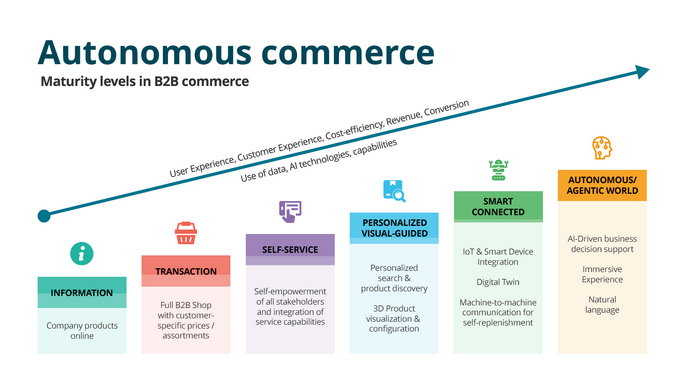
A-Commerce, short for Agentic Commerce, is the emerging model in which AI agents research, compare, negotiate, and complete purchases on behalf of consumers and businesses, with minimal or zero human input at the point of transaction. This isn’t a future vision. It is happening right now, and the data is unambiguous about the scale of the shift.
Whether you run an ecommerce store, a B2B sales operation, or a digital agency, understanding A-Commerce is no longer optional. It is the defining competitive factor of this decade.
What Is A-Commerce? Defining the Autonomous Shopping Era
Traditional ecommerce is human-led and click-driven. A shopper visits a website, browses products, adds items to a cart, and clicks through a checkout flow. Every step requires human attention and intention. A-Commerce flips this model entirely.
In the agentic model, an AI agent receives a goal from a user, such as ‘find the best running shoes under $120 and order them’ and then handles every downstream step autonomously. The agent queries product APIs, compares specifications and prices across platforms, applies stored preferences, and executes the transaction, all without the consumer navigating a single product page.
Google accelerated this shift in January 2026 with its official definition of agentic commerce as a system where AI does not just suggest products but actively helps complete the task of checking out. McKinsey defines it as AI that anticipates consumer needs, navigates shopping options, negotiates deals, and executes transactions. The word ‘agentic’ derives from ‘agency’, the capacity to take independent action, and that is precisely what separates these systems from the chatbots and recommendation engines of the previous decade. To make the most of this shift, brands need SEO-ready websites and digital infrastructure that AI agents can actually read and act on.
A-Commerce by the Numbers: 2024 vs 2026
Metric | 2024 Baseline | 2026 Projection |
Agentic AI Enterprise Value | $2.58 Billion | $6+ Billion (en route to $24.5B by 2030) |
Orgs Adopting Agentic AI | ~47% | ~79% (96% planning expansion) |
Revenue Uplift (AI Sales Teams) | 3–7% | 7–25% reported by adopters |
AI-influenced Online Sales (Cyber Wk) | ~10% of orders | ~20% of global digital orders |
A-Commerce Market Size | $135 Billion | $1.7 Trillion projected by 2030 |
Enterprise Apps with AI Agents | <5% | 40% by end of 2026 (Gartner) |
Key A-Commerce growth metrics comparing 2024 baselines to 2026 data and projections. Sources: Gartner, McKinsey, Grand View Research, Salesforce, Rye.
Three Forces Making A-Commerce Unstoppable in 2026
Why is the A-Commerce inflection point happening now and not two years from now? Three converging forces have brought the timeline forward dramatically.
Consumer Readiness
Shoppers have spent years trusting algorithmic recommendations from Spotify, Netflix, and Amazon. That habitual trust in AI suggestion engines has lowered the psychological barrier to delegating actual purchase decisions. Today, 45% of shoppers report using AI assistants to assist or complete purchases, and 52% say they are comfortable sharing shopping data with AI agents.
Maturing LLM Capabilities
Large language models in 2026 are capable of understanding nuanced preferences, contextual constraints, and multi-step planning in ways that 2023 models simply could not manage reliably. Modern AI agents can hold a user’s full shopping history, infer unstated preferences, and make judgment calls across thousands of product variables in seconds.
New Industry Standards and Protocols
The infrastructure for agent-to-agent commerce is now being built. Google launched its Agentic Commerce Protocol in January 2026, backed by Walmart, Target, Shopify, and 20+ partners. Mastercard and Google are co-developing Agent Pay, a secure payment rail designed for AI-initiated transactions. These protocols give agents standardized, machine-readable access to product catalogs, inventory, and checkout flows, the missing plumbing that makes at-scale A-Commerce operationally viable.
How the A-Commerce Customer Journey Works
Understanding the mechanics of an agentic purchase journey helps businesses identify where they need to adapt. The funnel below maps the five stages an AI agent moves through on a buyer’s behalf.
Goal Setting
The user tells an AI agent what they want in natural language, including budget, preferences, and constraints.
Discovery
The agent queries structured product APIs, not storefronts. It searches across retailers for matching SKUs in real time.
Evaluation
The agent compares products by price, reviews, return policy, shipping speed, and brand trust signals.
Stage 4: Decision
Using learned preferences and contextual reasoning, the agent selects the best match and prepares a purchase action.
Execution
The agent completes the checkout using Agent Pay or protocol-compliant checkout, then logs the transaction for the user.
The critical implication for retailers: the agent never sees your homepage. It reads your product data, your metadata, your API responses, and your checkout reliability. Brands that optimize for this structured, data-first environment will win visibility. Those that do not will simply be invisible to agents.
Related: How RF Studio builds SEO-optimized, agent-ready websites for growing businesses
Autonomous Sales Agents: The B2B and B2C Transformation
A-Commerce is not only a consumer phenomenon. In B2B contexts, autonomous sales agents are reshaping how businesses buy from each other at scale.
A fashion retailer’s inventory agent can analyze sales velocity across 50,000 SKUs and 200 stores, automatically placing supplier orders while accounting for seasonal demand and shipping delays. A B2B procurement agent can negotiate contract renewals by analyzing market rates, supplier performance metrics, and historical negotiation data to secure optimal terms, without a human buyer ever sitting across the table.
On the revenue side, the numbers are compelling. Companies using AI sales agents report 7% to 25% revenue increases and conversion rate improvements of up to 70%. McKinsey data confirms that businesses deploying these systems broadly see 3% to 15% revenue growth alongside 10% to 20% improvements in sales ROI. Eighty-six percent of sales teams using AI report positive ROI within their first year.
For digital agencies and growing businesses, the implication is that AI-powered outreach, lead qualification, and follow-up are now table stakes, not differentiators. RF Studio’s growth marketing services are increasingly built around these autonomous touchpoints.
What A-Commerce Means for Your Website and Digital Presence
The shift to A-Commerce does not make websites obsolete, but it fundamentally changes what makes a website effective. AI agents evaluate brands through structured data signals, not design aesthetics or UX flows. If your product data is incomplete, your metadata is thin, or your checkout is friction-heavy, you are not just ranking lower in search. You are being excluded from agent-mediated transactions entirely.
Adobe Analytics measured 42% higher conversion rates among AI-referred shoppers in Q1 2026 compared to traditional search traffic. That gap exists because agents pre-qualify intent before sending a buyer to your site, but only if your product data is clean, complete, and machine-readable enough to earn the referral in the first place.
The new performance metrics that matter in an A-Commerce world include found rate (does your product appear in agent results at all), position quality (are you a primary recommendation or a footnote), AI-referred conversion rate, and catalog completeness score. Traditional metrics like bounce rate and click-through rate tell only part of the story.
The Challenges A-Commerce Must Still Solve
Enthusiasm about A-Commerce is warranted, but a clear-eyed view demands acknowledging the friction points that remain.
The trust gap is real. While 52% of consumers are comfortable sharing data with AI shopping agents, 83% express concerns about privacy and data misuse. Brands that communicate clearly about how agents handle user data, and build transparent audit trails for every agent action, will earn the trust that drives adoption.
Payment infrastructure was not designed for AI agents as customers. Existing fraud detection systems, built around human behavioral patterns, may flag legitimate agent transactions as suspicious. Mastercard and Google are building Agent Pay specifically to address this, but widespread deployment is still maturing.
Gartner projects that over 40% of agentic AI projects will be canceled by end of 2027 due to escalating costs, unclear value propositions, and weak risk controls. The companies that will thrive are those that start narrow, measuring outcomes rigorously, and scale only what demonstrably works.
The highest-performing AI sales implementations in 2026 are not fully autonomous. They escalate exceptions, flag low-confidence decisions, and maintain clear handoff points to human team members. Full autonomy without oversight increases error rates and erodes internal trust faster than any individual mistake would.
How to Prepare Your Business for A-Commerce Now
The gap between AI-enabled and manually-operated businesses widens every quarter. AI-mature firms already report 25% to 30% higher process efficiency than peers using legacy tools. Here is where to focus your energy in 2026.
First, audit your product data and content quality. Agents read structure, not style. Every product needs accurate, complete metadata, clean categorization, and descriptive specifications that a machine can parse and rank. RF Studio’s SEO and content services are built to ensure your data ecosystem earns agent visibility.
Second, reduce checkout friction to zero. The biggest unsolved problem in A-Commerce today is checkout. Agents need frictionless, protocol-compliant checkout paths. Multi-step, login-required, or poorly structured checkout flows are the primary reason agent-initiated transactions fail to complete.
Third, invest in brand-consistent, high-performance design. Even in an agent-mediated world, the final conversion still happens on your website. When an agent sends a qualified buyer your way, that visitor arrives with high intent and expects a seamless experience. RF Studio’s creative design subscription services ensure your brand shows up with the professionalism that converts.
Fourth, pilot autonomous sales touchpoints. Start with one high-frequency, high-friction workflow, typically lead qualification or follow-up execution, and measure outcomes for 90 days before expanding. Companies deploying AI agents broadly report that revenue metrics take 90 to 120 days to flow through the pipeline, so patience at the measurement stage is essential.
The Commerce Playbook Has Changed
A-Commerce is not a trend to watch. It is the structural shift that is rewriting the rules of how products are discovered, evaluated, and purchased across every category and market. The brands, agencies, and sales teams that understand this shift and adapt their digital infrastructure, their data quality, and their customer experience will compound their advantages rapidly. Those that wait for certainty will find that the gap has already closed against them.
2026 is not the beginning of A-Commerce. It is the inflection point, the year when the infrastructure, the consumer readiness, and the AI capabilities aligned simultaneously. The question is not whether your business will be affected. The question is whether you will shape how it is affected, or simply react to it.
RF Studio helps businesses build the digital foundations that win in an agent-driven world: from SEO-optimized websites to high-performance Webflow development, Website-as-a-Service subscriptions, and brand design that converts. Ready to future-proof your digital presence? Let’s build it together.